Research Article | | Peer-Reviewed

Sociodemographic and Bioclinical Determinants of Strict Virological Suppression at 6 12 and 24 Months Among People Living with HIV: A Multicenter Retrospective Study (2019–2025) in Abidjan, Côte d’Ivoire

Received: 10 October 2026     Accepted: 22 October 2026     Published: 31 October 2026
Views:       Downloads:
Abstract

Background: Sustaining strict virological suppression is critical for mitigating treatment failure and preventing the emergence of drug-resistance mutations in people living with HIV. This multicenter. retrospective cohort study aimed to identify independent predictors of strict virological suppression (plasma viral load ≤ 20 copies/mL) at 6. 12. and 24 months post-antiretroviral therapy initiation among 334 PLHIV in Côte d’Ivoire. Methods and results: Sociodemographic and bioclinical data were retrieved from medical records across two health facilities between January 2019 and December 2025. Factors associated with strict virological suppression were evaluated using multivariable binary logistic regression analysis (reporting adjusted odds ratios and 95% confidence intervals). Diagnostic checks confirmed the absence of multicollinearity (variance inflation factors < 1.2). Strict virological suppression rates were 59.9% at 6 months. 64.4% at 12 months. and 65.0% at 24 months. Multivariable analysis demonstrated that high treatment adherence was the sole factor consistently and independently associated with virological success across all time points. Female sex and the healthcare facility level served as time-dependent independent predictors. Conclusion: Treatment adherence remains the paramount determinant of long-term strict virological suppression. Continuous strengthening of patient education and task-shifting toward primary care facilities are essential to sustain the long-term effectiveness of antiretroviral regimens.

Published in Central African Journal of Public Health (Volume 12, Issue 5)
DOI 10.11648/j.cajph.20261205.17
Page(s) 317-326
Creative Commons

This is an Open Access article, distributed under the terms of the Creative Commons Attribution 4.0 International License (http://creativecommons.org/licenses/by/4.0/), which permits unrestricted use, distribution and reproduction in any medium or format, provided the original work is properly cited.

Copyright

Copyright © The Author(s), 2026. Published by Science Publishing Group

Keywords

HIV/AIDS, Strict Virological Suppression, Treatment Adherence, Côte d’Ivoire

1. Introduction
Human immunodeficiency virus (HIV) infection remains a critical global public health challenge . The advent of combination antiretroviral therapy (cART) has fundamentally shifted the prognosis of HIV. transforming it from a fatal condition into a manageable chronic disease with life expectancy approaching that of the general population . Guidelines from the World Health Organization (WHO) and UNAIDS 95-95-95 targets underscore viral suppression as the cornerstone of HIV care—not only to arrest disease progression and lower mortality. but also to prevent sexual transmission .
Historically. virological success was defined by plasma viral load thresholds of < 1.000 or < 50 copies/mL . However. ultra-sensitive molecular assays now enable the evaluation of strict virological suppression. routinely defined at a threshold of ≤ 20 copies/mL. Achieving deep viral suppression is essential for minimizing residual viral replication. preserving future therapeutic options. and preventing drug-resistance mutations . The widespread adoption of first-line treatment regimens based on dolutegravir. in particular the tenofovir + lamivudine + dolutegravir (TLD) combination. has significantly improved virological suppression rates thanks to its strong genetic barrier to resistance and its good tolerability . Nevertheless. in clinical practice. the virological response to antiretroviral therapy (ART) varies from one individual to another and over time. It depends on a complex interplay between demographic factors (age. sex). clinical characteristics (HIV subtype. presence of comorbidities). the type of healthcare setting and. above all. long-term treatment adherence.
Whilst several studies have documented the factors associated with virological success at a given point in time, there is little real-world data that simultaneously analyses the dynamics of strict virological suppression (≤ 20 copies/mL) at key points during longitudinal follow-up (6, 12 and 24 months) across healthcare settings of varying levels, particularly in West Africa and Côte d’Ivoire, specifically under the optimized TLD regimen.
The aim of this study was to assess the proportion of people living with HIV achieving strict virological suppression (≤20 copies/mL) at 6, 12 and 24 months of follow-up, and to identify the sociodemographic and bio clinical factors associated with this suppression at each time point.
2. Materials and Methods
2.1. Type and Scope of the Study
This is a retrospective, analytical study involving people living with HIV who were starting or continuing antiretroviral therapy (ART) between January 2019 and December 2025. Data collection took place at two care sites representative of distinct levels of care in the city of Abidjan: a tertiary-level healthcare facility, namely the Pulmonology Department (PPH) at the Cocody University Hospital, and the Treichville Outpatient Care and Counselling Unit (USAC), from 1 to 31 July 2026.
2.2. Study Population and Eligibility Criteria
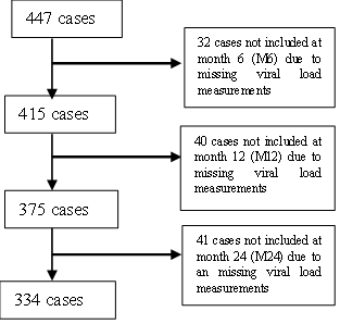
The study included a sample of 334 people living with HIV during the study period (Figure 1).
Figure 1. Flowchart illustrating the inclusion criteria for the study from 2019 to 2025.
Inclusion criteria: Patients were eligible if they had documented HIV infection (types 1. 2. or dual infection). were monitored at one of the study sites between January 2019 and December 2025. and possessed complete clinical records including plasma viral load measurements at designated intervals (M6. M12. or M24).
The starting point corresponds either to the initiation of ARV treatment for naïve patients, or to the date of inclusion in the study for patients already under treatment.
The evaluation windows were defined: M6 (5–7 months), M12 (11–13 months) and M24 (23–25 months).
For patients already receiving ARV treatment at the time of their registration, we checked and adjusted their overall follow-up duration to ensure a uniform longitudinal analysis.
2.3. Definition of Variables
The primary endpoint, or dependent variable, was virological suppression. This was defined as a plasma viral load of 20 copies/mL or less and was assessed at 6 months (M6), 12 months (M12) and 24 months (M24) of follow-up. This threshold corresponds to the lower limit of quantification of the molecular biology platforms used (e.g. Abbott RealTime HIV-1 / Cobas AmpliPrep / Cobas TaqMan) at the reference laboratory (IPCI).
The explanatory variables or independent variables were: the study site (tertiary care facility (PPH) versus outpatient care unit (USAC)), sociodemographic characteristics (gender, age), clinical characteristics (presence or absence of comorbidities), virological characteristics (HIV type (HIV-1, HIV-2, HIV-1+2)), treatment characteristics (ARV regimen based on tenofovir+ lamivudine + dolutegravir (TLD) versus other triple therapies) and adherence or non-adherence to medication was categorized as ‘Yes’ or ‘No’ based on the patient’s regular attendance at ARV dispensing appointments. The therapeutic adherence was assessed from the monitoring of regular renewal of prescriptions and pharmacy dispensing appointments (attendance rate ≥ 95% considered as “Yes”), supplemented by self-declarations recorded in medical records.
2.4. Statistical Analysis
Descriptive analysis: Qualitative variables were presented as frequencies and percentages, whilst quantitative variables were expressed as their mean, standard deviation or median and interquartile range, depending on their distribution.
Bivariate analysis: The association between each explanatory variable and virological suppression at 6, 12 and 24 months was assessed using Pearson’s chi-squared test or Fisher’s exact test for categorical variables, and using Student’s t-test or the Mann-Whitney test for age.
Multivariable analysis: A binary logistic regression model was constructed for each follow-up point (M6, M12, M24). The variables included in the initial model were those with a p-value < 0.25 in the bivariate analysis. Adjusted odds ratios (aOR) and their 95% confidence intervals (95% CI) were calculated to identify the independent predictors of virological success. A reference category for each explanatory variable was defined (e.g., Sex = Male; Site = USAC; Compliance = No; Treatment = Other). Regression analyses were performed using complete cases at each follow-up time point.
2.5. Ethical Considerations
The conduct of this study required approval from the medical and scientific management teams at the Cocody University Hospital and the Outpatient and Counselling Unit. The guidelines relating to the ethics of health research were adhered to. All information collected via this questionnaire from patients’ records was processed anonymously, stored in a computerized database and remained confidential.
3. Results
3.1. Viral Suppression and Bivariate Analysis
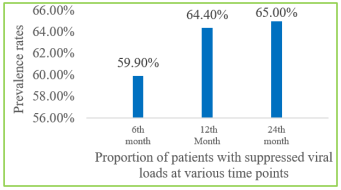
Of the 334 patients included in the study between 2019 and 2025, the proportion of patients achieving virological suppression rose from 59.9 per cent at the 6-month follow-up to 64.4 per cent at the 12-month follow-up and to 65.0 per cent at the 24-month follow-up (Figure 2).
Figure 2. Prevalence of patients achieving virological suppression at 6, 12 and 24 months of antiretroviral treatment.
In terms of the general characteristics of the study population, the average age of people living with HIV (PLHIV) was 46 years, with a predominance of women (66.2 per cent). Most patients had been recruited from the respiratory medicine department (PPH) (63.5 per cent). The majority were infected with HIV-1 (94 per cent), received antiretroviral therapy (ART) (88.3 per cent) and adhered to their medication (81.7 per cent). However, 26.6 per cent of them had at least one chronic comorbidity (Table 1).
In bivariate analysis, the treatment center (PPH versus USAC) and good medication adherence were significantly associated with virological suppression at all follow-up time points (p < 0.05). Female sex was significantly associated with better virological suppression at M6 (64.7% vs 50.4%, p=0.012) and at M12 (69.2% vs 54.9%, p=0.010). Furthermore, the absence of comorbidities was associated with higher virological suppression at 6 months (p=0.036) and at 24 months (p=0.022) (Table 1).
Table 1. General characteristics and bivariate analysis of socio-demographic and bioclinical factors associated with virological suppression at 6-, 12- and 24-months’ follow-up.

General specifications

Virological suppression at 6 months

Virological suppression at 12 months

Virological suppression at 24 months

n (%)

Yes n (%)

p-value

Yes n(%)

p-value

Yes n(%)

p-value

Total population

334(100)

200(59,9)

215(64,4)

217(65,0)

Study site

PPH

212(63,5)

137(64,6)

0.020

147(69,3)

0.012

157(74,1)

< .001

USAC

122(36,5)

63(51,6)

68(55,7)

60(49,2)

Sex

Woman

221(66,2)

143(64,7)

0.012

153(69,2)

0.010

147(66,5)

0.408

Man

113(33,8)

57(50,4)

62(54,9)

70(61,9)

Current age of patients

[18-30]

29(8,7)

17(58,6)

0.204

22(75,9)

0.056

19(65,5)

0.300

[30-40]

69(20,6)

43(62,3)

35(50,7)

45(65,2)

[40-50]

107(32,1)

62(57,9)

76(71,0)

72(67,3)

[50-60]

94(28,1)

51(54,3)

60(63,8)

54(57,4)

≥ 60

35(10,5)

27(77,1)

22(62,9)

27(77,1)

Comorbidity

No

245(73,4)

155(63,3)

0.036

161(65,7)

0.395

168(68,6)

0.022

Yes

89(26,6)

45(50,6)

54(60,7)

49(55,1)

HIV type

HIV 1

314(94,0)

187(59,6)

0.362

202(64,3)

0.488

202(64,3)

0.748

HIV 1+2

17(5,1)

10(58,8)

10(58,8)

13(76,5)

HIV 2

3(0,9)

3(100,0)

3(100)

2(66,7)

Combination of ARVs

TLD

295(88,3)

182(61,7)

0.063

194(65,8)

0.144

197(66,8)

0.057

Other

39(11,7)

18(46,2)

21(53,8)

20(51,3)

Medication adherence

No

61(18,3)

19(31,1)

< .001

21(34,4)

< .001

14(23,0)

< .001

Yes

273(81,7)

181(66,3)

194(71,1)

203(74,4)

3.2. Independent Factors Associated with Virological Suppression (Multivariable Analysis)
Adjusted logistic regression analysis revealed that at 6 months’ follow-up, good medication adherence (aOR = 4.31; 95% CI: [2.24 – 8.28]; p<0.001) and female sex (aOR=1.96; 95% CI: [1.18 – 3.23]; p=0.009) were the two independent predictors associated with virological suppression (Table 2).
Table 2. Multivariable analysis presenting adjusted odds ratios (aOR) and identifying factors associated with virological suppression at 6 months’ follow-up in people living with HIV.

Adjusted Odds Ratio (aOR)

p-value

95% Confidence Interval (95% CI)

Study site:

PPH

1.12

0.682

[0.65 - 1.95]

USAC

1

Age of patients:

[18-30]

1

[30-40]

1.62

0.327

[0.62 - 4.28]

[40-50]

1.03

0.955

[0.42 - 2.51]

[50-60]

0.99

0.997

[0.403 - 2.47]

≥ 60

2.96

0.069

[0.919 - 9.56]

Sex:

Woman

1.96

0.009

[1.185 - 3.23]

Man

1

Combination of ARVs:

TLD

1.385

0.414

[0.63 - 3.03]

Other

Treatment adherence:

YES

4.311

< .001

[2.24 - 8.28]

NO

1

Comorbidities:

NO

1.56

0.112

[0.902 - 2.72]

Yes

1

Note: Odds ratio for “Viral load suppression at 6 months = yes” versus “Viral load suppression at 6 months = no”

At 12 months, female sex (aOR = 2.05; 95% CI: [1.23 – 3.40]; p = 0.006) and adherence to treatment (aOR = 3.69; 95% CI: [1.96 – 6.94]; p<0.001) continued to exert a significant protective effect in favour of virological suppression (Table 3).
Table 3. Multivariable analysis presenting adjusted odds ratios (aOR) and identifying factors associated with virological suppression at 12 months’ follow-up.

Adjusted Odds Ratio (aOR)

p-value

95% Confidence Interval (95% CI)

Study site:

PPH

1.54

0.125

[0.89- 2.66]

USAC

1

Age of patients:

[18-30]

2.04

0.228

[0.64 – 6.47]

[30-40]

0.67

0.390

[0.27 – 1.66]

[40-50]

1.45

0.392

[0.618 – 3.40]

[50-60]

1.09

0.849

[0.46 – 2.56]

≥ 60

Sex:

Woman

2.05

0.006

[1.23 – 3.40]

Man

1

Combination of ARVs:

TLD

1.06

0.892

[0.47 – 2.38]

Other

1

Medication adherence:

Yes

3.67

< .001

[1.96 – 6.94]

No

1

Note: Odds ratio for ‘Viral load suppression at 12 months = yes’ versus ‘Viral load suppression at 12 months = no’

At 24 months, medication adherence becomes the major predictive factor, increasing the probability of virological suppression by more than eightfold (aOR = 8.33; 95% CI: [4.23 – 16.42]; p < 0.001). At this late time point, the PPH study site also emerged as an independent factor favoring virological suppression compared with the USAC centre (aOR = 2.04; 95% CI: [1.17 – 3.57]; p = 0.012) (Table 4).
Table 4. Multivariable analysis presenting adjusted odds ratios (ORs) and identifying factors associated with virological suppression at 24 months’ follow-up.

Adjusted Odds Ratio (aOR)

p-value

95% Confidence Interval (95% CI)

Study site:

PPH

2.04

0.012

[1.17 – 3.57]

USAC

1

Comorbidity:

No

1.48

0.172

[0.84 – 2.62]

Yes

Combination of ARVs:

OTHER

1.19

0.668

[0.53 – 2.73]

TLD

1

Treatment adherence:

YES

8.33

< .001

[4.23 - 16.42]

NO

Note: Odds ratio for “Viral load suppression at 24 months = yes” versus “Viral load suppression at 24 months = no”

3.3. Validation of Diagnostic Models for Multicollinearity
Tests of the multicollinearity assumptions for the three models (Tables 2, 3 and 4) confirm the reliability of the results. All variance inflation factors (VIFs) range between 1.01 and 1.19 (well below the critical threshold of 5 or 10) and confirm the absence of multicollinearity between the explanatory variables (Table 5).
Table 5. Summary of Adjusted Odds Ratios (ORa) and Independent Factors.

Follow-up time

Independent factor

Reference category

ORa

95% CI

p-value

6 months (M6)

Gender (Female)

Man

1,96

[1,18 – 3,23]

0,009

High adherence

No

4,31

[2,24 – 8,28]

< 0,001

12 months (M12)

Gender (Female)

Man

2,05

[1,23 – 3,40]

0,006

High adherence

No

3,69

[1,96 – 6,94]

< 0,001

24 months (M24)

Site (PPH)

USAC

2,04

[1,17 – 3,57]

0,012

High adherence

No

8,33

[4,23 – 16,42]

< 0,001

PPH is Tertiary care center; High adherence: medication adherence (Yes)

4. Discussion
This multicenter retrospective study of 334 people living with HIV (PLHIV) in Côte d’Ivoire provides quantitative data on the dynamics and predictive factors of strict virological suppression ≤ 20 copies/mL at 6, 12 and 24 months of follow-up.
With regard to the overall dynamics of strict virological suppression in our cohort, the proportion of patients achieving strict virological suppression rose from 59.9% at 6 months to 64.4% at 12 months, before stabilizing at 65.0% at 24 months. These rates may appear to fall short of the UNAIDS ‘95-95-95’ targets for viral load control . However, the use of a particularly stringent threshold (≤ 20 copies/mL) explains this difference. Whilst WHO guidelines define treatment failure as a viral load exceeding 1,000 copies/mL, achieving a strict suppression threshold is now recognized as minimizing the risk of low-level viremia, reducing the risk of subsequent virological failure and preventing the emergence of resistance mutations .
Our findings confirm that medication adherence serves as the foundation for both short- and long-term virological efficacy. Adherence emerged as the most consistent predictor of strict viral suppression across all observation time points. This finding corroborates those of several studies carried out in the Democratic Republic of the Congo (DRC) , Kenya , Botswana , Uganda and Ethiopia , which have also highlighted a strong association between good treatment adherence and virological suppression. The strength of association between adherence and viral suppression intensified markedly over time (aOR increased from 4.31 at M6 to 8.33 at M24).
These findings reinforce the notion that adherence is not only necessary for the initial induction of viral control, but remains essential for maintaining deep viral suppression and preventing viral resurgence in the long term. In our study, although 88.3% of patients received an optimized dolutegravir-based treatment regimen (TLD), the overall adherence rate was 81.7%. This finding confirms that, despite dolutegravir’s high genetic barrier and strong efficacy, adherence to treatment remains the ultimate determinant of virological response .
With regard to the link between gender and virological response, this study reveals an early advantage in virological suppression among women. Female sex is an independent factor associated with better virological suppression at 6 months (aOR = 1.96; p = 0.009) and at 12 months (aOR = 2.05; p = 0.006). This finding is consistent with the findings of certain authors , . However, this independent association diminishes at 24 months. This result is consistent with the study by Mosha et al., in which women had lost their initial immunological advantage, showing weaker immune recovery after one year of treatment .
This early advantage for women can be explained by several contextual and socio-behavioral factors in sub-Saharan Africa. On the one hand, women often benefit from earlier diagnosis through antenatal care programs and programs to prevent mother-to-child transmission (PMTCT). Furthermore, several studies have documented that women are more likely to attend medical follow-up appointments and adhere more closely to treatment guidelines from the outset than men, who tend to seek medical advice later and at more advanced clinical stages. This observation is supported by the study by Kwendra and colleagues in Bunia, in the Democratic Republic of the Congo, who found that male sex is a factor associated with failure to achieve viral suppression .
Hawkins and colleagues had also shown that men were at a significantly higher risk of immunological non-response after at least 6 months of antiretroviral treatment , and Mongo-Delis and colleagues had found that mortality was higher among men than among women .
The loss of statistical significance at M24 suggests that, in the longer term, the quality of individual adherence takes precedence over gender. This finding corroborates the study by Billioux and colleagues in Uganda, who found that support for long-term adherence is necessary to achieve robust viral suppression and represents a priority in resource-limited settings .
The treatment centre also influences strict virological suppression, highlighting the challenges of decentralization. Whilst it was not predictive at 6 and 12 months in the multivariable analysis, the tertiary care setting (PPH at Cocody University Hospital) emerged as an independent factor favoring virological suppression at 24 months (aOR = 2.04; p = 0.012) compared with the outpatient facility (USAC in Abidjan).
This finding highlights a structural challenge in long-term monitoring. Tertiary-level facilities generally have more comprehensive technical resources, greater continuity in the supply of viral load reagents, and multidisciplinary teams with more experience in managing treatment interruptions or adherence issues beyond two years. This underlines the need to strengthen technical support and continuing professional development in community-based facilities (USACs) in order to maintain equity of care in the long term. This recommendation is consistent with the work of Boyer and colleagues, whose analyses based on multilevel regression models show that decentralized HIV services achieve results as good as those of centralized services, and even better results for certain criteria, such as adherence, mental well-being and affordability for households .
Although the presence of chronic comorbidities (26.6 per cent of the population) showed a negative association with HIV virological suppression in bivariate analysis at M6 and M24, this effect was not sustained in the adjusted multivariable analysis. This suggests that the link between comorbidities and virological response is likely mediated by treatment adherence (medication burden) or by confounding variables.
From a methodological perspective, the assessment of variance inflation factors (VIF [1.01–1.19]) ensures the absence of multicollinearity and confirms the robustness and statistical stability of our logistic regression models.
Strengths and limitations
The strengths of this study include the large number of study sites, the 24-month longitudinal analysis, the use of a strict virological suppression threshold (≤ 20 copies/mL) and the validation of the non-collinearity of the variables. However, it has limitations due to its retrospective design, which relies on medical records and may result in information bias or missing data. Excluding patients without available viral load results may introduce selection bias (potential overestimation of the suppression rate in patients who are regular at follow-up) Furthermore, the measurement of adherence in medical records is often based on self-reporting or the renewal of prescriptions, which may overestimate actual adherence. A key limitation of this study lies in the unavailability of comprehensive model diagnostics, which restricts a deeper analysis of its internal behavior. The uncontrolled difference between the sites also represents a limitation of the study.
5. Conclusion and Recommendation
This multicenter retrospective study provides concrete evidence of the long-term effectiveness of HIV management in Côte d’Ivoire, by assessing virological suppression to a strict threshold (≤ 20 copies/mL). Our results show satisfactory progress in viral suppression over the first two years, reaching a plateau of 65.0 per cent at 24 months.
The multivariable analysis highlights the temporal dynamics of the factors associated with virological success. In the short and medium term (M6 and M12), female sex is independently associated with a better virological response, likely reflecting earlier access to care and better initial adherence. In the long term (M24), management at a tertiary-level facility (PPH) offers a better guarantee of sustained viral control, highlighting the need to strengthen the capacity of local healthcare centers (USAC). However, the uncontrolled difference between the sites represents a limitation of the study.
At every stage of follow-up, treatment adherence emerges as the key and indispensable determinant of strict virological suppression, with its predictive impact increasing considerably over time (aOR = 8.33 at 24 months). In light of these findings, three priority areas emerge for optimizing care: Strengthen therapeutic education and support for adherence on an ongoing basis, without relaxing support for patients who are stable in the long term, even when on effective dolutegravir-based regimens.
Focus more closely on male populations from the time of diagnosis in order to reduce delays in treatment initiation and improve their retention within the care pathway from the very first months.
Implementing technical support and a transfer of skills from tertiary care centers to primary care centers (USAC) could ensure equitable quality in virological monitoring across the entire country.
Abbreviations

USAC

Outpatient Care and Counselling Unit

PMTCT

Program to Prevent Mother-to-Child Transmission

TLD

Tenofovir Lamivudine Dolutegravir

PLHIV

People Living with HIV

ART

Antiretroviral Therapy

WHO

World Health Organization

UNAIDS

United Nations Programme on HIV/AIDS

PPH

PneumoPtysiology Hospital

Acknowledgments
We thank the PneumoPtysiology department at the Cocody University Hospital and the outpatient care and counseling unit in Treichville, in the city of Abidjan.
Author Contributions
Kpadraux Danielle Odegué: Conceptualization, Data curation, Formal Analysis, Investigation, Methodology, Project administration, Resources, Software, Supervision, Validation, Visualization, Writing – original draft, Writing – review & editing
Marcelle Money: Conceptualization, Data curation, Formal Analysis, Investigation, Methodology, Project administration, Visualization, Writing – original draft, Writing – review & editing
Félicité Beudjé: Conceptualization, Data curation, Formal Analysis, Investigation, Methodology, Visualization, Writing – original draft, Writing – review & editing
Kouao Maxime Diané: Conceptualization, Investigation, Methodology, Resources, Software, Validation, Visualization, Writing – review & editing
Jean-Jacques Renaud Dechi: Investigation, Methodology, Project administration, Resources, Software, Supervision, Validation, Visualization, Writing – original draft, Writing – review & editing
Taté Roger Oulahi: Investigation, Methodology, Project administration, Resources, Software, Supervision, Validation, Visualization, Writing – original draft, Writing – review & editing
Boko Alexandre Kouassi: Validation, Visualization, Writing – original draft, Writing – review & editing
Arsène Adon: Validation, Visualization, Writing – review & editing
Solange Kakou-Ngazoa: Validation, Visualization, Writing – review & editing
Mireille Dosso: Validation, Visualization, Writing – review & editing
Data Availability Statement
The data supporting the results of this study are available on reasoned request to the principal investigator, Odegue K.D. These data are not publicly available due to confidentiality or ethical restrictions.
Conflicts of Interest
The authors declare no conflicts of interest.
References
[1] UNAIDS, « Fiche d’information — Dernières statistiques sur l’etat de l’epidemie de sida | UNAIDS », UNAIDS. Consulte le: 2 octobre 2026. [En ligne]. Disponible sur:
[2] Rodolphe Garraffo, « Traitement de l’infection VIH: Les associations d’antiretroviraux à longue duree d’action, avantages et inconvenients », vih.org. Consulte le: 2 octobre 2026. [En ligne]. Disponible sur:
[3] ONUSIDA, « Indetectable = Intransmissible — Sante publique et suppression de la charge virale du VIH », 2024.
[4] G. A. Namayanja et al., « High viral suppression rates among PLHIV on dolutegravir who had an initial episode of viral non-suppression in Uganda September 2020-July 2021 », PloS One, vol. 19, no 6, p. e0305129, 2024,
[5] WHO, « Le rôle de la suppression virale du VIH dans l’amelioration de la sante individuelle et la reduction de la transmission ». Consulte le: 2 octobre 2026. [En ligne]. Disponible sur:
[6] H. Chaouch et al., « Reponse virologique au traitement par le Dolutegravir », 27es Journ. Natl. D’Infectiologie, vol. 5, no 2, Supplement, p. S157, juin 2026,
[7] UNAIDS, « Strategie mondiale de lutte contre le sida 2026-2031 | UNAIDS ». Consulte le: 3 octobre 2026. [En ligne]. Disponible sur:
[8] G. Y. Numbi et E. Al, « Les determinants associes à la suppression de la charge virale chez les personnes vivant avec le VIH sous traitement à base de Dolutegravir », Rev. Malienne Infect. Microbiol., vol. 20, no 3, p. 45‑55, 2025,
[9] E. K. Maina, H. Mureithi, A. A. Adan, J. Muriuki, R. M. Lwembe, et E. A. Bukusi, « Incidences and factors associated with viral suppression or rebound among HIV patients on combination antiretroviral therapy from three counties in Kenya », Int. J. Infect. Dis., vol. 97, p. 151‑158, août 2020,
[10] O. T. Bareng et al., « Low-Level Viremia among Adults Living with HIV on Dolutegravir-Based First-Line Antiretroviral Therapy Is a Predictor of Virological Failure in Botswana », Viruses, vol. 16, no 5, p. 720, mai 2024,
[11] G. W. Assefa, T. Y. Yimer, et W. C. Tassew, « Rate of Viral Resuppression and Predictors Among PLHIV on Second-Line Antiretroviral Therapy at Gondar Comprehensive Specialized Hospital, Northwest, Ethiopia: A Retrospective Cohort Study », J. Int. Assoc. Provid. AIDS Care, vol. 25, p. 23259582261439620, 2026,
[12] S. Mannheimer, G. Friedland, J. Matts, C. Child, et M. Chesney, « The consistency of adherence to antiretroviral therapy predicts biologic outcomes for human immunodeficiency virus-infected persons in clinical trials », Clin. Infect. Dis. Off. Publ. Infect. Dis. Soc. Am., vol. 34, no 8, p. 1115‑1121, avr. 2002,
[13] Diakite M 1, Keita BB 2, Drabo M 2, Traore M 1, Keita B 3, Soumoutera A, « (PDF) Impact de la tritherapie antiretrovirale contenant le Dolutegravir sur la suppression de la charge virale chez les PVVIH suivis au Cen », ResearchGate, juin 2026,
[14] F. Mosha, « Gender Differences in Human Immunodeficiency Virus (HIV) Disease Progression and Treatment Outcomes », Chapters, 2021, Consulte le: 3 octobre 2026. [En ligne]. Disponible sur:
[15] M. Floridia, M. Giuliano, L. Palmisano, et S. Vella, « Gender differences in the treatment of HIV infection », Pharmacol. Res., vol. 58, no 3‑4, p. 173‑182, 2008,
[16] A. L. Kwendra et al., « Reponses virologiques du VIH après un accompagnement à l’observance du traitement antiretroviral à Bunia, RD Congo : une etude de cohorte prospective », Kivu Med. J., vol. 4, no 1, p. 1‑12, juill. 2026,
[17] C. Hawkins et al., « Sex differences in antiretroviral treatment outcomes among HIV-infected adults in an urban Tanzanian setting », AIDS, vol. 25, no 9, p. 1189‑1197, juin 2011,
[18] A. Mongo-Delis et al., « Facteurs influençant la perte de vue et la mortalite chez les personnes vivant avec le VIH suivies au Centre de Traitement Ambulatoire de Koula-Moutou (Gabon) de 2005 à 2015 », Pan Afr. Med. J., vol. 24, 2016,
[19] A. Billioux et al., « Durable Suppression of HIV-1 after Virologic Monitoring-Based Antiretroviral Adherence Counseling in Rakai, Uganda », PLoS ONE, vol. 10, no 5, p. e0127235, mai 2015,
[20] S. Boyer, « Decentralisation et performance des services de prise en charge des personnes vivant avec le VIH/SIDA dans les pays à faibles ressources : l’experience du Cameroun », juill. 2010.
Cite This Article
  • APA Style

    Odegué, K. D., Money, M., Beudjé, F., Diané, K. M., Dechi, J. R., et al. (2026). Sociodemographic and Bioclinical Determinants of Strict Virological Suppression at 6 12 and 24 Months Among People Living with HIV: A Multicenter Retrospective Study (2019–2025) in Abidjan, Côte d’Ivoire. Central African Journal of Public Health, 12(5), 317-326. https://doi.org/10.11648/j.cajph.20261205.17

    Copy | Download

    ACS Style

    Odegué, K. D.; Money, M.; Beudjé, F.; Diané, K. M.; Dechi, J. R., et al. Sociodemographic and Bioclinical Determinants of Strict Virological Suppression at 6 12 and 24 Months Among People Living with HIV: A Multicenter Retrospective Study (2019–2025) in Abidjan, Côte d’Ivoire. Cent. Afr. J. Public Health 2026, 12(5), 317-326. doi: 10.11648/j.cajph.20261205.17

    Copy | Download

    AMA Style

    Odegué KD, Money M, Beudjé F, Diané KM, Dechi JR, et al. Sociodemographic and Bioclinical Determinants of Strict Virological Suppression at 6 12 and 24 Months Among People Living with HIV: A Multicenter Retrospective Study (2019–2025) in Abidjan, Côte d’Ivoire. Cent Afr J Public Health. 2026;12(5):317-326. doi: 10.11648/j.cajph.20261205.17

    Copy | Download

  • @article{10.11648/j.cajph.20261205.17,
      author = {Kpadraux Danielle Odegué and Marcelle Money and Félicité Beudjé and Kouao Maxime Diané and Jean-Jacques Renaud Dechi and Taté Roger Oulahi and Boko Alexandre Kouassi and Arsène Adon and Solange Kakou-Ngazoa and Mireille Dosso},
      title = {Sociodemographic and Bioclinical Determinants of Strict Virological Suppression at 6 12 and 24 Months Among People Living with HIV: A Multicenter Retrospective Study (2019–2025) in Abidjan, Côte d’Ivoire},
      journal = {Central African Journal of Public Health},
      volume = {12},
      number = {5},
      pages = {317-326},
      doi = {10.11648/j.cajph.20261205.17},
      url = {https://doi.org/10.11648/j.cajph.20261205.17},
      eprint = {https://article.sciencepublishinggroup.com/pdf/10.11648.j.cajph.20261205.17},
      abstract = {Background: Sustaining strict virological suppression is critical for mitigating treatment failure and preventing the emergence of drug-resistance mutations in people living with HIV. This multicenter. retrospective cohort study aimed to identify independent predictors of strict virological suppression (plasma viral load ≤ 20 copies/mL) at 6. 12. and 24 months post-antiretroviral therapy initiation among 334 PLHIV in Côte d’Ivoire. Methods and results: Sociodemographic and bioclinical data were retrieved from medical records across two health facilities between January 2019 and December 2025. Factors associated with strict virological suppression were evaluated using multivariable binary logistic regression analysis (reporting adjusted odds ratios and 95% confidence intervals). Diagnostic checks confirmed the absence of multicollinearity (variance inflation factors < 1.2). Strict virological suppression rates were 59.9% at 6 months. 64.4% at 12 months. and 65.0% at 24 months. Multivariable analysis demonstrated that high treatment adherence was the sole factor consistently and independently associated with virological success across all time points. Female sex and the healthcare facility level served as time-dependent independent predictors. Conclusion: Treatment adherence remains the paramount determinant of long-term strict virological suppression. Continuous strengthening of patient education and task-shifting toward primary care facilities are essential to sustain the long-term effectiveness of antiretroviral regimens.},
     year = {2026}
    }
    

    Copy | Download

  • TY  - JOUR
    T1  - Sociodemographic and Bioclinical Determinants of Strict Virological Suppression at 6 12 and 24 Months Among People Living with HIV: A Multicenter Retrospective Study (2019–2025) in Abidjan, Côte d’Ivoire
    AU  - Kpadraux Danielle Odegué
    AU  - Marcelle Money
    AU  - Félicité Beudjé
    AU  - Kouao Maxime Diané
    AU  - Jean-Jacques Renaud Dechi
    AU  - Taté Roger Oulahi
    AU  - Boko Alexandre Kouassi
    AU  - Arsène Adon
    AU  - Solange Kakou-Ngazoa
    AU  - Mireille Dosso
    Y1  - 2026/10/31
    PY  - 2026
    N1  - https://doi.org/10.11648/j.cajph.20261205.17
    DO  - 10.11648/j.cajph.20261205.17
    T2  - Central African Journal of Public Health
    JF  - Central African Journal of Public Health
    JO  - Central African Journal of Public Health
    SP  - 317
    EP  - 326
    PB  - Science Publishing Group
    SN  - 2575-5781
    UR  - https://doi.org/10.11648/j.cajph.20261205.17
    AB  - Background: Sustaining strict virological suppression is critical for mitigating treatment failure and preventing the emergence of drug-resistance mutations in people living with HIV. This multicenter. retrospective cohort study aimed to identify independent predictors of strict virological suppression (plasma viral load ≤ 20 copies/mL) at 6. 12. and 24 months post-antiretroviral therapy initiation among 334 PLHIV in Côte d’Ivoire. Methods and results: Sociodemographic and bioclinical data were retrieved from medical records across two health facilities between January 2019 and December 2025. Factors associated with strict virological suppression were evaluated using multivariable binary logistic regression analysis (reporting adjusted odds ratios and 95% confidence intervals). Diagnostic checks confirmed the absence of multicollinearity (variance inflation factors < 1.2). Strict virological suppression rates were 59.9% at 6 months. 64.4% at 12 months. and 65.0% at 24 months. Multivariable analysis demonstrated that high treatment adherence was the sole factor consistently and independently associated with virological success across all time points. Female sex and the healthcare facility level served as time-dependent independent predictors. Conclusion: Treatment adherence remains the paramount determinant of long-term strict virological suppression. Continuous strengthening of patient education and task-shifting toward primary care facilities are essential to sustain the long-term effectiveness of antiretroviral regimens.
    VL  - 12
    IS  - 5
    ER  - 

    Copy | Download

Author Information
  • Department of Technical and Technological, Pasteur Institute of Côte d’Ivoire (IPCI), Abidjan, Côte d’Ivoire

  • Biological Resources Centre (CEREB), Pasteur Institute of Côte d’Ivoire (IPCI), Abidjan, Côte d’Ivoire

  • Natural Substances and the Monitoring of Micro-organism Resistance to Anti-infectives (ASSURMI), Pasteur Institute of Côte d’Ivoire (IPCI), Abidjan, Côte d’Ivoire

  • Biological Resources Centre (CEREB), Pasteur Institute of Côte d’Ivoire (IPCI), Abidjan, Côte d’Ivoire

  • Laboratory of the Regional Blood Transfusion Centre, Yamoussoukro, Côte d’Ivoire

  • Department of General Hygiene and Health Promotion, National Institute of Public Health, Abidjan, Côte d'Ivoire

  • Department of Respiratory Medicine, Cocody University Hospital, Abidjan, Côte d’Ivoire

  • Department of Technical and Technological, Pasteur Institute of Côte d’Ivoire (IPCI), Abidjan, Côte d’Ivoire

  • Department of Technical and Technological, Pasteur Institute of Côte d’Ivoire (IPCI), Abidjan, Côte d’Ivoire

  • Department of Bacteriology and Virology, Pasteur Institute of Côte d’Ivoire (IPCI), Abidjan, Côte d’Ivoire